


Content creation changed my life.
4 years ago, I was a broke college student, making $500/month, living off of the 2 meals my university provided.
Couldn’t eat out. Couldn’t afford coffee because it was out of my budget. Wouldn’t go out on the weekends because I couldn’t afford dinner.
So in 2023, I started writing online.
Didn’t have any social media experience. No skills. No money.
A complete beginner and dead broke.
I still remember saving up for 8 months just so I could afford Dan Koe’s 2 Hour Writer and Kieran Drew’s High Impact Writing courses (still one of the best investments I ever made).
And let me tell you…
My first 16 months of writing were absolute hell.
3 months to get my first 100 followers and make my first $20.
16 months to reach my first 1,000 followers.
17 months to make my first $1,000/month.
19 months to my first $4,000 month.
But today, as I’m approaching my 3rd year of writing online, I’ve now:
Gained 90M+ views
Built an audience of 33,000+
Make over $8,000+/month doing what I love.
My Monday mornings are the same as Saturday mornings.
And the best part?
I have a life that I’m absolutely in love with.
I workout for 3 hours a day, build products I love, and help people improve their lives.
I also get to make decent money doing it.
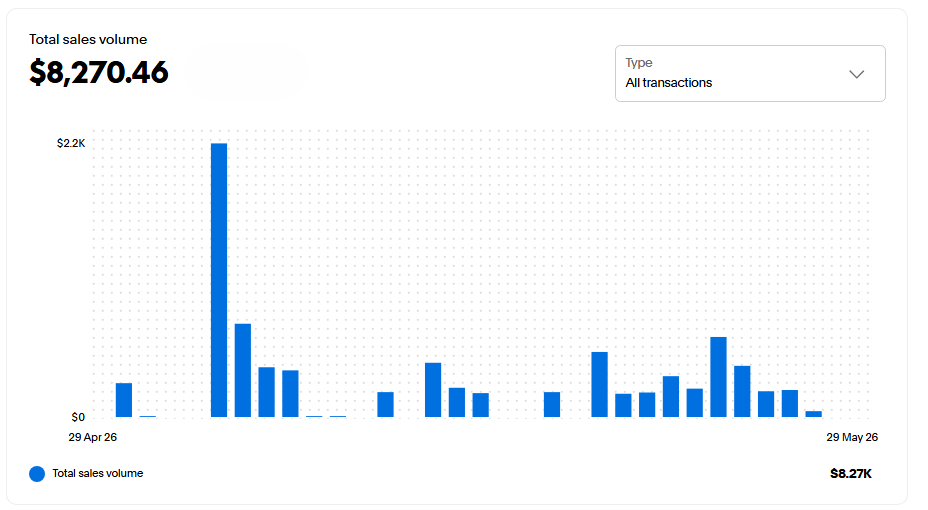
I cringe whenever I post screenshots like these. But I do know how powerful it is when it comes to motivating people.
A huge reason why I have this lifestyle now?
Building an audience.
Without an audience, you don’t have a business.
Why?
Because to start a business, you need customers, and what better way to find customers than to build an audience first?
Here’s why an audience is the best way to start a business:
They already know you and trust you (which makes selling a product a lot easier).
You don’t need to do cold outreach (your audience already has your customer avatar).
When you have an audience, you can pivot, create new products in different spaces, and still have people buying regardless.
You don’t need to spend money on ads to market your products. You can simply promote your product to your audience and get customers.
I can keep going, but I think you get the point.
Why you can’t get out of beginner’s hell (even when you’re doing everything right)
6-12 months.
That’s how long it takes people to get out of beginner’s hell.
I’ve now coached over 30 creators. Helped them gain tens of thousands of followers and make over $20,000+ in student wins.
I’ve also talked to 150 more creators.
From all of the conversations, there are 3 mistakes that keep people stuck and unable to grow.
Mistake #1 - You can’t commit to a strategy
Social media is filled with FOMO.
Everywhere you look, you see someone post about a brand new strategy that has helped them add 1,274 readers in 24 hours, and your mind thinks: “This is what I need to be doing.”
Then you add it to your workflow.
Tomorrow comes around, then you see some other random guy say something similar about a different strategy, then you try that one.
Don’t you realize what you’re doing?
You can’t grow because you’re not committed. You keep switching, hoping something works.
My friend, all of these strategies work.
You just need to commit long enough with one to see results.
If you’re trying 5 different things at once, you’re not going to improve or learn anything. You’re doing a whole lot of work for not a whole lot of results.
Pick one, commit to it for 90 days, and if you don’t see the results you had hoped for, try another one.
But for the love of God, don’t switch strategies every day. You won’t see any results like that.
Mistake #2 - You’re relying on tactics too much
Trends come and go.
That means if you always rely on the latest “hack”, you’ll always struggle to grow.
Because once a trend dies, you’re back to square one and can’t grow. Then you’re forced to change strategies or your content to continue to grow.
Don’t get me wrong.
I’m not saying don’t use templates and structures.
I follow trends, use templates, and structures myself.
But what I’m saying is don’t follow trends blindly. Don’t use templates without trying to understand what makes them work.
You need to be conscious of what you’re creating.
Dissect everything.
When you’re using templates, ask yourself:
How do they capture attention?
How do they deliver on the idea?
How are the hooks written?
How is the post structured?
How does it make the reader feel?
Use templates as training wheels to understand what makes a great post.
Mistake #3 - You’re trying to grow everywhere
This is a mistake I’ve seen many beginners fall for.
They see a guy with millions of followers and his content workflow.
A newsletter gets turned into a podcast, 20 tweets, 3 threads, and a YouTube video.
His tweets get repurposed to Instagram, LinkedIn, Threads, and Substack.
His YouTube video gets clipped and turned into 15 Reels and TikToks.
It's a whole system from just one piece of writing, his newsletter.
So then you try to do the same.
But what you don’t realize is that that’s his FULL-TIME JOB.
That’s what he does for a living.
And also, he already has the audience to do it. That means he already had an audience on Twitter/X and so when they started posting on Instagram, they could funnel their Twitter audience to Instagram and use that to boost their initial growth.
You don’t even have 200 followers on any platform.
You have a job, a partner, friends, a mortgage, and a million other things to do other than just writing and creating content.
What people also miss is that every platform works differently. Different hooks work on different platforms. What works on Twitter doesn’t work 100% on LinkedIn.
People on LinkedIn are more interested in work-related topics. Not so much about self-improvement, philosophy, or writing.
So where should you start creating?
Substack.
Why?
Because it does two things really well.
You can host your newsletter on it and it acts as a blog (so every newsletter gets saved).
It has a built-in growth mechanism for your newsletter with Notes (which is basically tweets that people see on their timeline and then they can join your newsletter).
Your newsletters get posted to people’s timelines (this helps you get discovered by people who aren’t subscribed to your newsletter).
Even though I’m a huge Twitter/X fan (because I like how unhinged the platform is), Substack is great for growth.
In just the past 30 days, I gained 1,300 new email subscribers from Substack alone.
So how do you do it?
How do you actually grow an audience?
How do you finally escape beginner’s hell so you can start earning money from it?
Let me show you.
How to finally escape beginner’s hell (in 2026)
Let’s get one thing straight:
You don’t need to be on 5 different platforms at once.
You need to get good at growing on one platform.
Once you learn the skill of how to grow an audience (yes, building an audience is a skill that can be learned), then you can start thinking of adding another platform to your mix.
My advice:
Grow on one platform.
Get really good at it.
Once you have some sort of audience (10,000 followers minimum), then you can use your already existing audience to fuel your audience growth on a different platform (your followers want to see more of you).
I started posting on Substack when I had 19,000 followers on Twitter.
In my first 24 hours, I gained 2,400 followers.
How?
I funneled my audience from Twitter to Substack and used it to fuel my initial growth on Substack.
That’s what you need to do.
Do not start from zero on all platforms and try to grind your way out.
Here’s how I’d grow an audience (as a complete beginner).
I - Pick a topic you’re interested in
This is pretty straightforward.
Pick a topic you can’t shut up about. The one where you can speak for hours on end without getting bored. One that excites you whenever someone brings it up.
Writing content is easy when you write about something you love.
II - Create your tribe of mentors
Your success as a creator depends on the quality of your ideas.
The quality of your ideas is entirely dependent on the content you consume on a daily basis.
The 2-4 hours you spend scrolling on your phone.
What are you watching?
Is it useful?
Is it educational?
How does it contribute to your success as a creator?
You need to be highly selective about who you follow, watch, and listen to.
If you’re struggling to find ideas or feel like your content is shit, you need to increase the quality of your input (content you consume).
Go on a social media diet.
Curate your algorithm to only give you high-quality content and not some brain rot.
Create a list of the creators you look up to.
The ones that make you think:
“Damn, I wish I wrote that.”
These are the people you need to be consuming.
They will help you find ideas, become more articulate, and take action.
Inside of Eden (the software I use to write and create all of my content and products), you can create a list and add these creators.
For example, I have a list for creators who are in the one-person business niche.
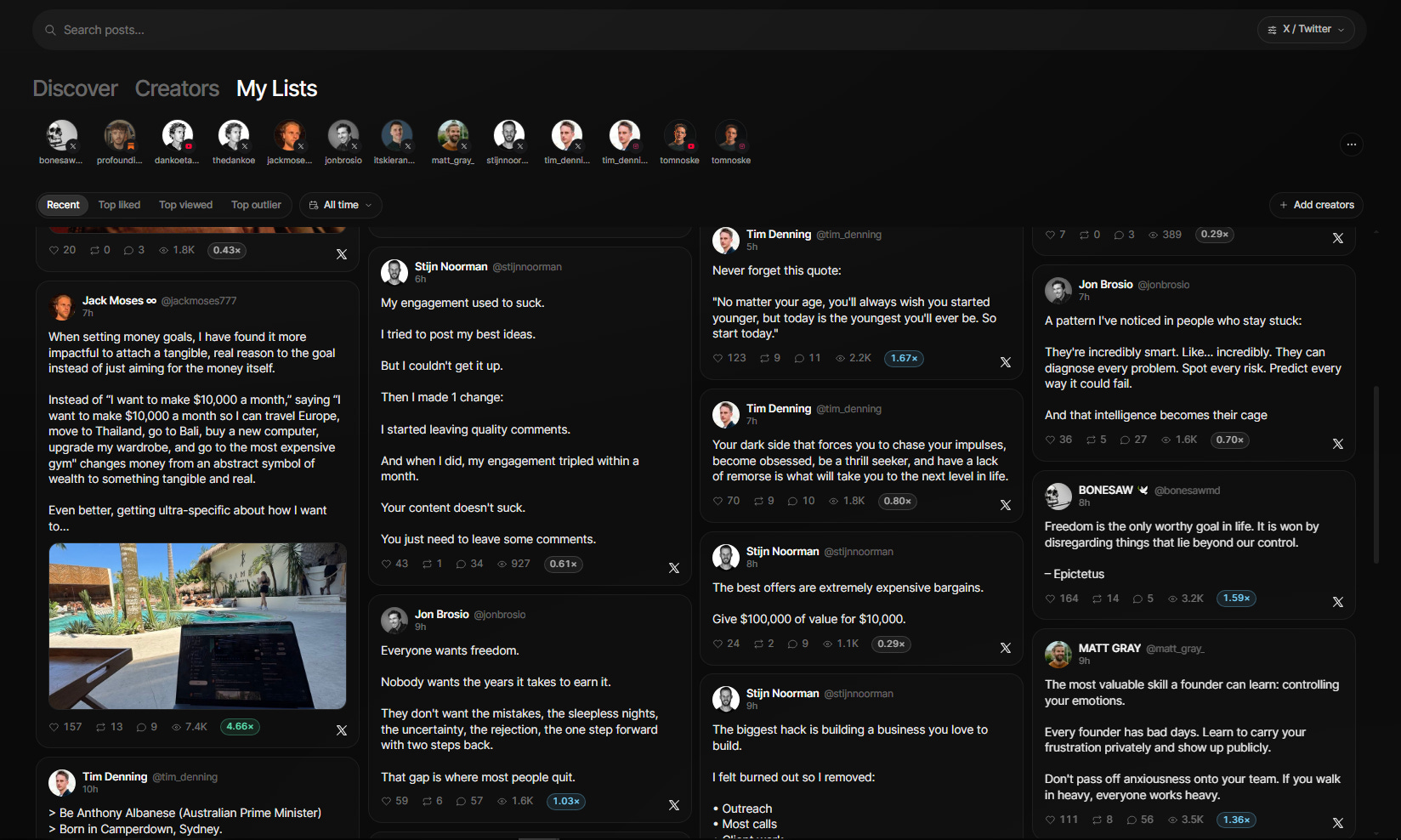
Then you can stalk them (like I do).
The best part?
You’re not limited to one platform.
You can add creators from different platforms (Twitter, Substack, IG, TikTok, LinkedIn, YouTube) to the same list.
Now, you have a curated feed to consume and go to whenever you need inspiration.
III - Find high-performing ideas
If I had to summarize content creation to one point, it would be this.
If your goal is to get views, build an audience, and escape beginner’s hell, then you need to write about high-performing ideas.
Nobody reads your posts because they’re boring.
They want to see what they already like.
Do what works.
Scrolling your timeline is a horrible way to find ideas.
Go back to the list you created in Eden, and search for keywords.
For example, let’s say I’m trying to write a Twitter thread about stress. But I don’t know what angle to take, how to structure it, or make it interesting.
All I have to do is open the List I created, search for “Chronic Stress” and I have a list of already validated ideas.
You can even filter with “Top outliers” if you just want to see viral content.
So how do you find high-performing ideas?
Inside of Eden, you can go to the list you’ve just created (for your Tribe Of Mentors), and search for keywords.
For example, say I’m trying to write a tweet about stress.
But I don’t know how to make it interesting. I can search for “Chronic Stress” and I immediately have high-performing ideas.
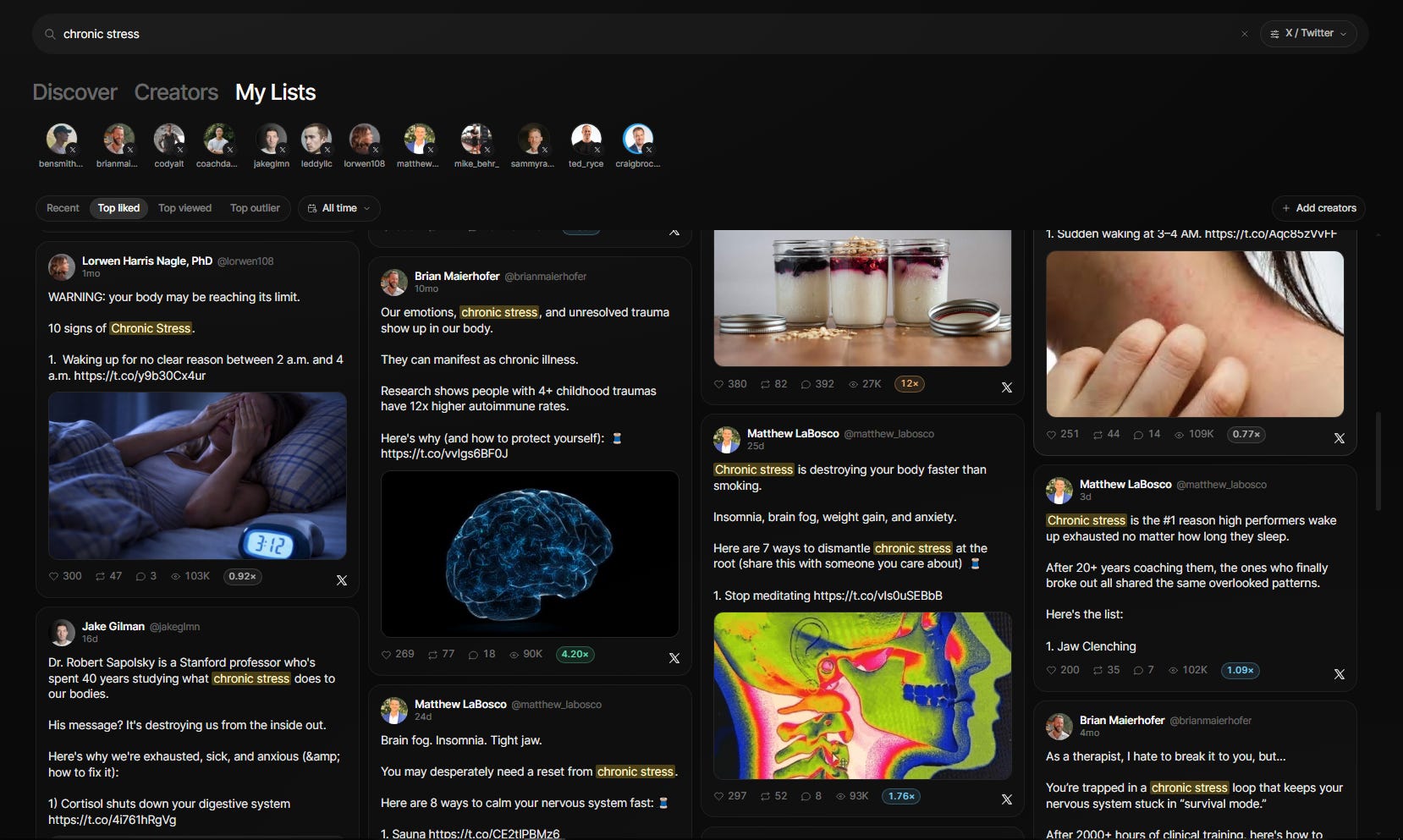
Now, you know what is already working.
You don’t need to guess what people want to see.
You can also see the hooks and their threads and spot the gaps and introduce a new perspective that no one talked about until now. This way, you get to see what’s already working for others and adapt it to your own content and benefit from it.
I’m not saying that you should copy others.
No.
What I’m saying is you need to know how to make your ideas interesting for other people to care enough about to read.
IV - Use validated structures
Let’s be honest.
Your content probably sucks.
Mine did too.
For a long time I thought my content was great but when I reached rock bottom and was on the verge of quitting writing forever, I dedicated 30 days to studying great content, and my god...
My content was horrible.
If you want to capture attention and build an audience, you need to learn how to write high-impact content.
The easiest way to write high-impact content?
Listicles.
Why listicles?
They are easy to write.
They deliver value quickly.
They hold the most attention.
They have the highest word-to-value ratio.
They help you condense big ideas into small, digestible chunks.
They are the highest-performing pieces of content across all platforms.
The way I write my listicles is something like this:
Make a strong claim in your first line
Follow up with 3-5 actionable steps people can take
End with a hard-hitting line so people remember you
Let’s say my idea is “how to change your life”.
If I wanted to write a listicle, it would be something like this:
6-12 months is all it takes to completely change your life.
- Remove distractions
- Cut out toxic friends
- Disappear from society
- Laser in on ONE big goal
- Find the 3-5 level-moving tasks
- Execute like a madman
Your friends, phone and hangouts can wait.
Your future cannot.
You can also find structures that have worked in the past for others and use the same structures to mold your ideas.
When you’re using structures, frameworks, and templates, don’t make the mistake of just copying without thinking.
Do it intentionally. Do it for the sake of learning and understanding why it works.
“But Hussain, I don’t want to copy others.”
Don’t you get it?
You still have a small audience.
Your goal isn’t to be the most creative and original. Your goal is to simply understand the game, and once you understand it and are consistently growing, start experimenting with different methods and be creative.
V - Create a record of your best hits
At this point, you should start seeing some results with your content.
Your engagement has picked up, audience is growing, and you know what you’re doing. You also have a few posts that went “viral.”
Virality is subjective. It depends on your audience size and engagement levels. What I consider viral is someone else’s “average post”.
A few reasons why you should do this:
You create a database of your own “validated ideas.”
Whenever you don’t know what to post (or don’t have time to write), you can just copy and paste one of your Best Hits and post it again.
You discover patterns that work exclusively for you.
Every week, I go to Eden, search for my own account, and look at my posts.
Any post that “went viral” (got over 100 likes on Twitter), gets added to a board called my Best Hits.
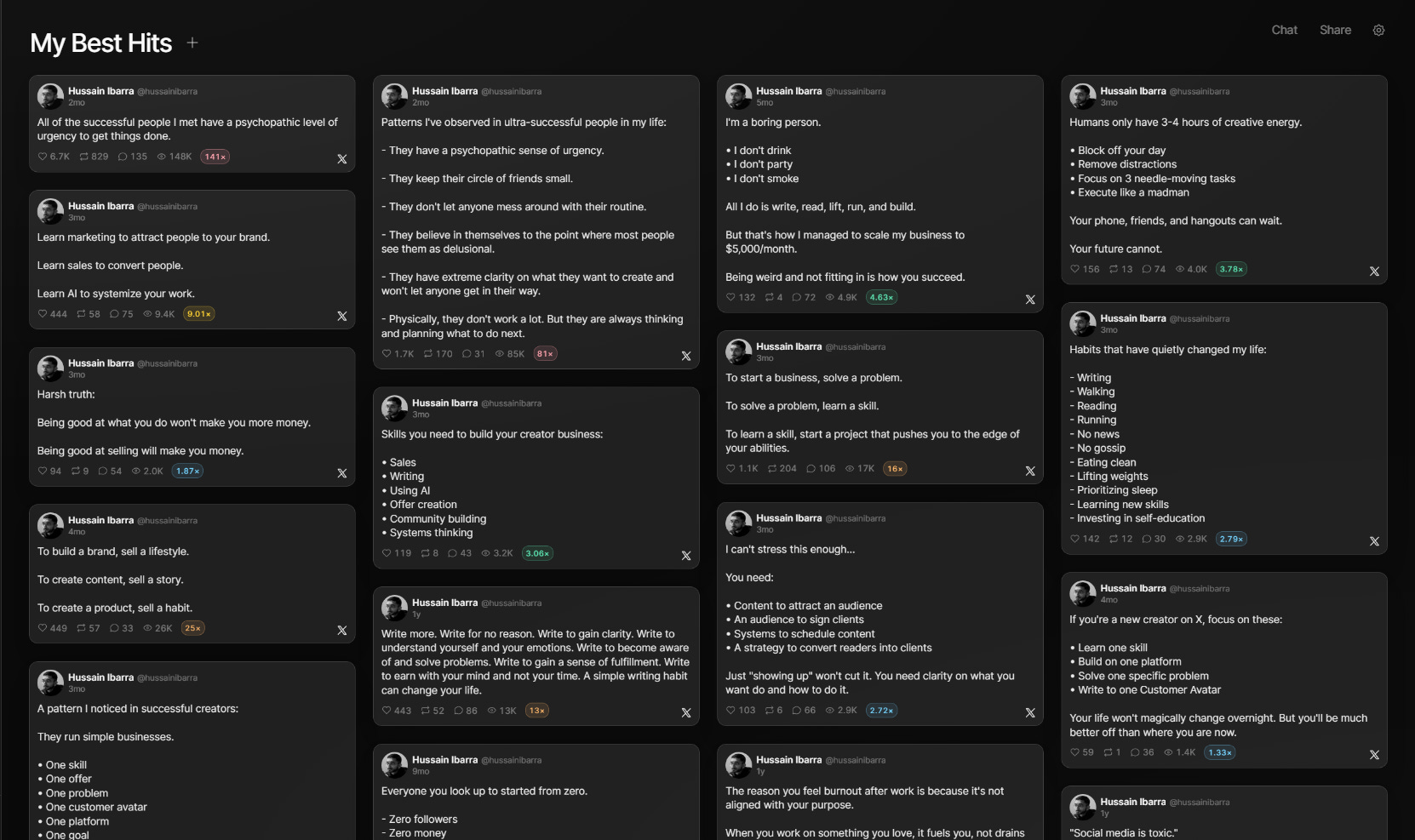
Whenever I need to write a tweet, or forget to schedule one, or am simply too busy to write I can copy and paste any of these tweets and I know they’ll do well.
Very simple. Very effective way of growing.
VI - Keep doing it until it stops working
Your audience is literally telling you what they want to see from you.
Your Best Hits is what your audience wants to see.
It is how you get more engagement (from your existing audience) and also exposes you to a wider audience (because the algorithm will push your content more when it sees it’s getting engagement).
I’m pretty shameless when it comes to repurposing my content.
If a tweet does well, I reuse it within 2-4 weeks.
I don’t change a word.
Just take a look at these two posts.


They’re exactly the same.
Didn’t change a single word, but still, the second time I posted it, I got 741k views.
It didn’t do as well as the first time.
But I didn’t put in any extra effort.
All I did was copy-paste my post and it has done well.
That’s not the only thing you can do.
You can also expand on idea that has done well.
Like what I did here:
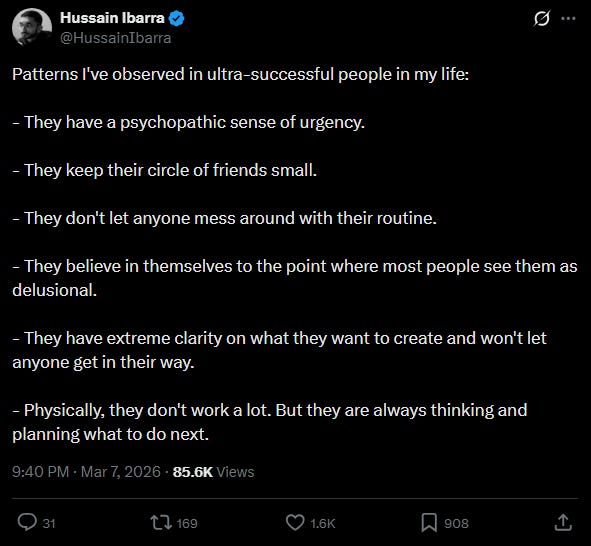
Because the tweet did well, it tells you that people like the idea. It’s a validated idea. Which means you can write a thread, a newsletter, or even create a YouTube video and expect it to perform well.
I turned the tweet into a thread.
And this was the result:

I’m not reinventing the wheel.
I’m just following the signal.
Your audience is LITERALLY telling you what they want to see.
You just need to listen.
When you have a post that does well, it tells you a few things:
You have an idea that’s working
Your audience wants to see more about the same topic
You have a validated structure you can use for your other ideas
The worst thing you can do is have a post that does well, and then you let it pass you.
Milk it.
Take Dan Koe, for example.
90% of his success came from a few winning ideas:
The 4-hour workday
Your life is a video game
The one-person business
Psychic entropy & flow state
Writing is the greatest skill of the 21st century
Look at his newsletters. They’re always around these 5 ideas.
He might take a different approach each time, but they’re always the same.
And he built an audience of 6M+ followers.
You don’t need new ideas.
You just need a handful and keep repeating them until that’s what you’re known for.
That’s how you build an audience in 2026.
That’s how you finally escape beginner’s hell.
Thank you for reading.
Enjoy the rest of your day.
— Hussain
P.S.
The tool that I’ve been using in this entire newsletter is called Eden.
It’s where I write all of my ideas, content, create my products, and store my prompts.
If you want to try it for yourself, you can get a 7-day free trial here.
Trying to grow everywhere at once sounds productive, but it usually just spreads your learning too thin.
Pick one place and stay there long enough to learn what works.
It's great to hear that I wasn't the only one saving pennies for potent instruction.
Never regretted any purchase I've made in this space.